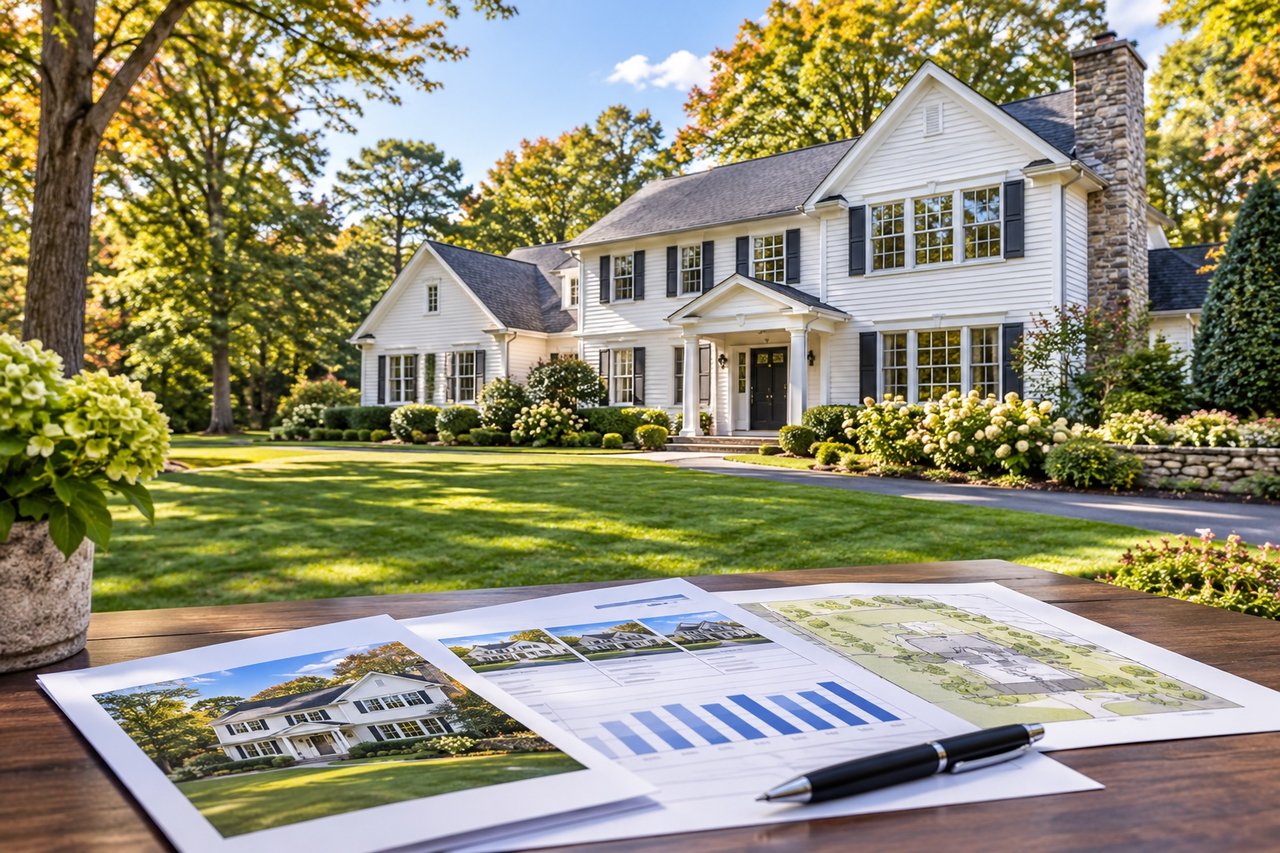
How to Price a Home in Weston, CT Using Comparable Sales
By James Boyles | Homes by Jim Boyles
How much is your Weston, Connecticut, home really worth?
If you are thinking about selling, you may have already checked an online home value estimator, looked at a neighbor's sale, or considered what you paid for the property. Each can provide context, but none should determine your asking price on its own.
Weston homes can differ substantially in architecture, condition, land, privacy, updates, and usable living space. Two properties with similar square footage can appeal to different buyers and command different prices.
That is why an effective pricing strategy starts with comparable sales, commonly called comps, and then examines how your property compares with the homes buyers are considering today.
At Homes by Jim Boyles, the goal is to build a pricing recommendation from evidence rather than guesswork.
What are comparable sales?
Comparable sales are properties that have recently sold and share meaningful characteristics with the home being valued.
A real estate professional typically examines recent closed transactions, active listings, pending sales where reliable information is available, and properties that failed to sell.
Each category answers a different question:
- Closed sales: What buyers actually agreed to pay in completed transactions.
- Pending sales: What the current market may be accepting, although final prices and terms may not yet be public.
- Active listings: What buyers can choose instead of your home.
- Expired or withdrawn listings: What may not have worked under the previous pricing and marketing strategy.
Closed sales usually provide the strongest starting evidence. Active listings reveal competition, but an asking price is not proof of market value.
Step 1: Start with the most relevant Weston sales
A useful comparable is not simply the closest house or the one with the highest sale price.
The best candidates have similar features and appeal to a similar group of buyers. Relevant considerations include:
- Property type and architectural style.
- Above-ground living area and overall layout.
- Number of bedrooms and bathrooms.
- Lot size, usability, and topography.
- Age, condition, and quality of renovations.
- Garage, basement, and other functional space.
- Privacy, setting, and outdoor amenities.
- Location within Weston and any meaningful differences in access or surroundings.
The most recent comparable sale is not always the best comparable. A slightly older transaction involving a much more similar home may offer better evidence than a recent sale of a substantially different property.
A strong analysis considers both similarity and timing.
Step 2: Look beyond square footage
Price per square foot is a useful reference point, but it is not a complete valuation method.
Imagine two hypothetical Weston homes, each with 3,000 square feet.
One has an updated kitchen, well-maintained systems, flexible living space, and a usable backyard. The other has dated finishes, deferred maintenance, and a layout that requires substantial changes to suit many buyers.
Even though their stated square footage is the same, buyers may perceive their value differently.
The same issue applies to finished basements, additions, enclosed porches, and other spaces. The way an area is finished, documented, accessed, and used can affect how it compares with other properties.
The lesson: Compare homes by their overall utility and condition, not just by dividing the sale price by the square footage.
Step 3: Understand what the land contributes
In Weston, land can be an important part of a property's appeal. But a larger lot does not automatically translate into a proportionately higher sale price.
Consider the difference between land that provides privacy, usable lawn, attractive outdoor space, or a desirable setting and land that is steep, heavily wooded, constrained, or otherwise difficult to use.
A careful analysis should consider the property's actual characteristics rather than relying on acreage alone.
Other factors may include:
- The way the house sits on the lot.
- Privacy and the relationship to neighboring properties.
- Landscaping and outdoor living areas.
- Driveway access and parking.
- Drainage and other site conditions.
- Applicable zoning, wetlands, septic, or other property-specific constraints.
These factors should be verified where relevant. A valuation should not assume that land can be subdivided, expanded, or developed without appropriate supporting evidence.
Step 4: Account for condition and improvements
Sellers often ask whether a renovation will increase the home's value by the amount spent.
The answer depends on the improvement, the quality of the work, buyer expectations, and the alternatives available in the market.
A renovated kitchen may make a home more attractive compared with an otherwise similar property that needs work. However, the cost of the renovation does not automatically translate dollar-for-dollar into additional market value.
When comparing homes, distinguish between:
- Cosmetic updates and major renovations.
- Routine maintenance and deferred repairs.
- Improvements that change functionality and those that mainly change appearance.
- Documented work and work for which permits or records may be incomplete.
The goal is to estimate how buyers are likely to value the difference, using comparable transactions and market evidence whenever possible.
Step 5: Study the competition buyers see today
A home does not compete only with properties that have already sold. It competes with the alternatives currently available to buyers.
Suppose several similar homes are listed in the same general price range. If your home is priced noticeably higher, buyers may need a compelling, objectively supportable reason to choose it.
On the other hand, a property with a distinctive setting, superior condition, or features that are scarce among current listings may warrant a different position.
This is where a pricing analysis becomes a strategy rather than a simple calculation.
Ask:
- Which active listings would a buyer most likely compare with my home?
- What does my property offer that those homes do not?
- What advantages do competing homes have?
- Are any competing listings adjusting their prices?
- How have similar homes performed after coming to market?
The answers help establish a credible position for the launch.
Step 6: Don't confuse the tax assessment with market value
Connecticut homeowners sometimes use their municipal assessment as a starting point for estimating what their property could sell for.
However, a property tax assessment is not the same as a current market valuation.
The Town of Weston explains that taxable property is generally assessed at 70% of its estimated market value for the applicable assessment date. Weston completed its most recent town-wide real estate revaluation as of October 1, 2023, with the next scheduled for 2028, subject to applicable changes and procedures.
Those assessment rules are designed for taxation, not to establish the asking price for a home being sold today.
You can review the Town of Weston's Assessor information for official assessment details.
For a selling decision, use current comparable sales, the property's condition, and the competitive market rather than treating the assessment as a current offer of value. <Cite refs={["turn675080search2"]}/>
Step 7: Use online estimates as a starting point—not the final answer
Automated valuation tools can help homeowners understand broad trends, but they may not fully account for the features that make a particular Weston property different.
An algorithm may have difficulty distinguishing between two homes with similar recorded characteristics but different renovation quality, privacy, site conditions, layouts, or documentation.
Online estimates can be useful for generating questions. A property-specific comparative market analysis can investigate those questions in greater detail.
Step 8: Choose a price based on the evidence and your goals
A pricing recommendation should explain not only the suggested asking price, but also why that position makes sense.
A practical pricing discussion should cover:
- The most relevant closed sales and their similarities to your property.
- The adjustments or differences that matter most.
- The strongest competing listings.
- The likely buyer pool for the home.
- Your preferred timeline and financial objectives.
- The marketing and presentation plan.
- The signals that would justify revisiting the strategy.
There is no single pricing formula that guarantees a particular sale price or timeline. The purpose of a thorough analysis is to make the decision more informed and the strategy easier to evaluate.
A hypothetical Weston pricing example
Imagine that three properties appear to be potential comparables for your home.
Property | Sale or asking price | Important distinction |
|---|---|---|
Comparable A | $1,200,000 | Similar size and condition; recently sold |
Comparable B | $1,275,000 | More extensive renovations and a different lot |
Comparable C | $1,350,000 | Currently listed; larger usable outdoor area |
These figures are illustrative only and are not actual Weston transactions or a valuation of any property.
The correct conclusion is not to average the three numbers and automatically use the result as your asking price.
Instead, determine which property is most similar, assess the differences, establish whether the active listing is competitively priced, and review other relevant sales. Only then can you develop a defensible price range.
Frequently asked questions
How many comparable sales should be used?
Quality matters more than quantity. A few highly relevant sales can be more useful than a large collection of properties that differ significantly from the home being valued. A professional may review additional transactions to understand the broader market.
Should I price my Weston home above market value to leave room for negotiation?
That approach can reduce interest if it places the property outside buyers' expectations. The appropriate strategy depends on current competition, buyer demand, the property's strengths, and your goals. A negotiation buffer should not replace evidence-based pricing.
Do improvements always increase a home's value?
No. Improvements may improve marketability and buyer perception, but their contribution depends on the work, quality, cost, and competing properties.
Can I determine my home's value from a neighbor's sale?
A neighbor's sale is worth investigating, but the homes may differ in condition, size, layout, lot characteristics, and timing. One sale rarely tells the whole story.
How often should I update my pricing analysis?
Review the analysis before listing and monitor meaningful changes while the home is on the market. New comparable sales, competing listings, price changes, and buyer feedback may affect the strategy.
Get a personalized Weston home valuation
Your home deserves more than a broad estimate or a price copied from a nearby listing.
I'm James Boyles of Homes by Jim Boyles. I approach pricing by examining the evidence, identifying the property's strongest selling points, and comparing it with the alternatives buyers can choose from.
If you are considering selling in Weston, I can help you understand the comparable sales, assess the competition, and discuss a pricing strategy suited to your property and goals.
Take the next step:
- Request a home valuation
- Explore Weston real estate
- Contact James Boyles
- Call (203) 772-9328
A well-supported pricing decision starts with understanding what makes your home different—and what buyers are actually paying for comparable properties.
This article is for general educational purposes. The hypothetical prices are illustrative, not current market data. A property's market value and appropriate asking price require an individualized analysis using reliable, current information.