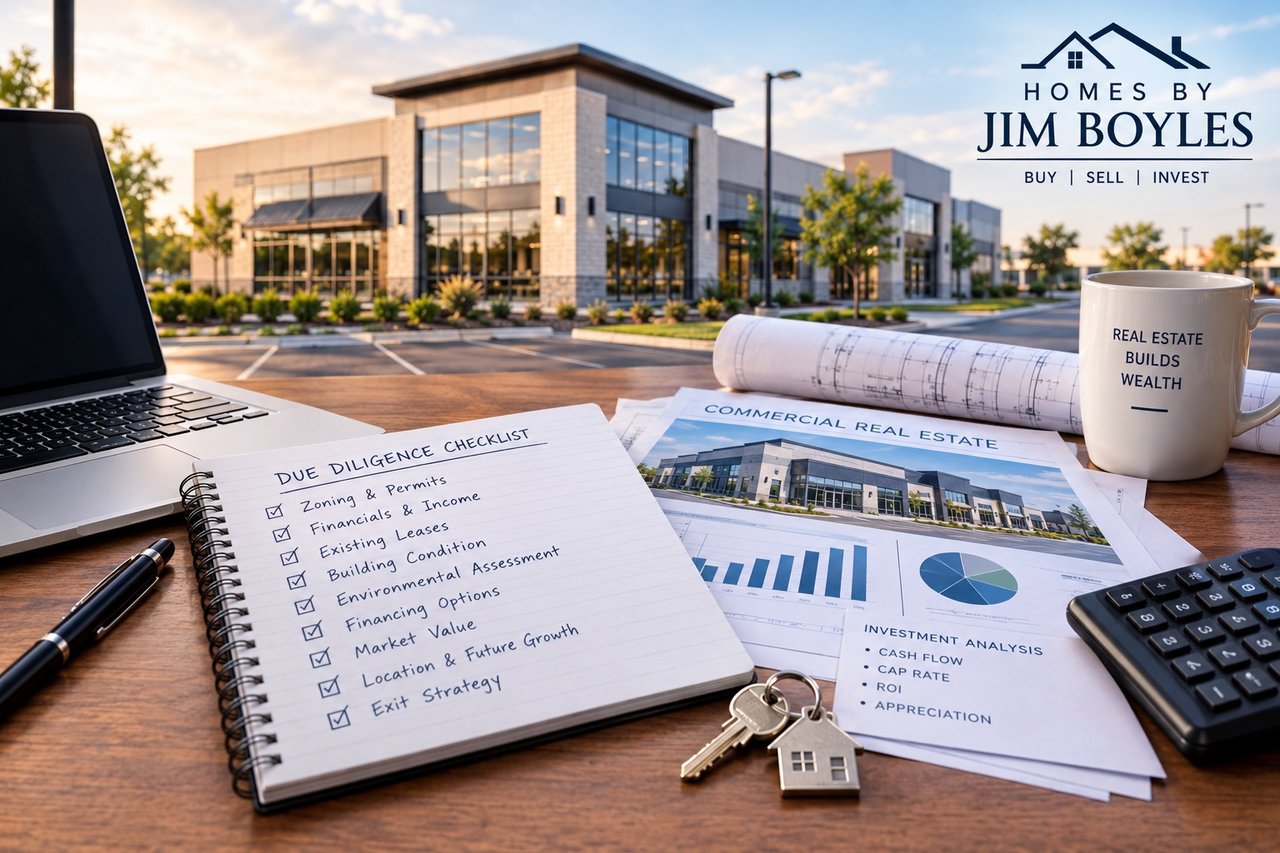
What Questions Should I Ask Before Buying a Commercial Building?
The essential commercial real estate due-diligence questions every buyer should answer before signing a purchase agreement.
Buying a commercial building can be an excellent way to build long-term wealth, create business stability, generate rental income, or diversify a real estate portfolio.
But commercial real estate is very different from buying a typical residential property.
The purchase price is only one part of the equation.
Before buying a commercial building, you need to understand the property's zoning, condition, income potential, operating expenses, leases, financing, environmental risks, location, and future resale potential.
The right questions can help you identify a great investment.
The wrong questions—or failing to ask them—can turn an attractive property into an expensive problem.
At Homes by Jim Boyles, I help buyers look beyond the building itself and evaluate the bigger real estate opportunity.
Here are some of the most important questions to ask before buying a commercial building.
1. What Is the Property Currently Used For?
Start with the basics.
Ask:
- What is the building currently being used for?
- How long has it been used for that purpose?
- Is the current use legal and permitted?
- Are there any restrictions on how the property can be used?
- Could the property be converted to another use?
- Is expansion or redevelopment possible?
A building may look perfect for your business or investment strategy, but that does not necessarily mean the property's zoning allows your intended use.
Zoning requirements are generally controlled at the local level and can restrict or prohibit certain types of businesses from operating at a property.
Before you become emotionally attached to a property, confirm that you can legally use it the way you intend.
2. What Are the Zoning and Land-Use Restrictions?
This is one of the most important questions when buying commercial real estate.
Find out:
- What is the current zoning classification?
- What uses are permitted?
- What uses require special approval?
- Are there parking requirements?
- Are there signage restrictions?
- Can you add square footage?
- Can you add another structure?
- Are there setback requirements?
- Are there restrictions on operating hours?
- Are there planned zoning changes?
The property's future potential can be just as important as its current use.
For example, a property that works for your business today may have significantly more value if it can be expanded, subdivided, redeveloped, or converted in the future.
3. What Is the Property's Current Income?
If you're purchasing an income-producing property, don't simply look at the asking price.
Ask for the actual financial information.
Questions should include:
- What is the current gross rental income?
- What is the net operating income (NOI)?
- What are the annual operating expenses?
- How much are property taxes?
- How much is insurance?
- Who pays utilities?
- Who pays maintenance?
- Are there management expenses?
- Are there outstanding expenses or liabilities?
- What is the property's historical income?
You want to understand what the building actually produces, not what the seller believes it could produce.
4. What Are the Existing Lease Terms?
If tenants are already occupying the building, the leases become extremely important.
Review:
- Current rent
- Lease expiration dates
- Renewal options
- Rent increases
- Security deposits
- Tenant improvement obligations
- Maintenance responsibilities
- Options to terminate
- Assignment or subleasing provisions
- Tenant payment history
You should also determine whether the current leases will remain in place after the sale.
A building with strong tenants and favorable leases can be significantly different from a building where multiple leases are about to expire.
5. Who Are the Tenants?
Don't just ask how much rent is being collected.
Ask who is paying it.
Consider:
- How financially stable are the tenants?
- How long have they been operating?
- How long have they occupied the building?
- Have they consistently paid rent?
- Are they local businesses or national companies?
- Is the property dependent on one major tenant?
- Are there vacant spaces?
- How difficult would those spaces be to lease?
Tenant quality can have a major impact on the stability and risk of an income-producing commercial property.
6. What Is the Condition of the Building?
A commercial property inspection can uncover problems that aren't obvious during a normal showing.
Evaluate major systems including:
- Roof
- HVAC
- Electrical
- Plumbing
- Foundation
- Structural components
- Windows and doors
- Parking lot
- Drainage
- Fire protection systems
- Sprinklers
- Elevators, if applicable
- Exterior façade
- ADA-related requirements
- Deferred maintenance
Ask:
What will this building cost me over the next 5, 10, and 15 years?
A lower purchase price doesn't necessarily mean a better investment if the property requires major capital improvements immediately after closing.
EPA guidance notes that real estate due diligence can involve evaluating building conditions, zoning, potential liens, encroachments, and other characteristics affecting the property's transfer or future use.
7. Is an Environmental Assessment Needed?
This is an area commercial buyers should take seriously.
Depending on the property's history and intended use, environmental due diligence may be appropriate.
Potential concerns can include:
- Underground storage tanks
- Previous industrial uses
- Petroleum products
- Hazardous substances
- Contamination
- Asbestos
- Mold
- Radon
- Other environmental conditions
A Phase I Environmental Site Assessment (ESA) is commonly used to investigate potential environmental concerns.
The EPA describes environmental due diligence as a process for evaluating environmental conditions and potential liability associated with contamination.
For certain transactions, environmental due diligence can also be important for potential federal liability protections.
Don't assume the seller's statement that "there have never been any problems" is enough.
8. What Are the Total Costs of Ownership?
One of the biggest mistakes a commercial buyer can make is focusing only on the purchase price.
Your real cost may include:
Purchase price + closing costs + financing + taxes + insurance + maintenance + repairs + capital improvements + management + utilities + vacancy
Ask:
- What are the annual property taxes?
- What is the insurance cost?
- What are typical maintenance expenses?
- How much has been spent on repairs?
- Are major capital improvements needed?
- What utilities does the owner pay?
- Are there common-area expenses?
- Are there management fees?
The goal is to determine your true cost of ownership.
9. How Much Financing Will the Property Support?
Before making an offer, talk with a commercial lender.
Ask:
- How much can I borrow?
- What interest rate can I expect?
- What down payment is required?
- What will the monthly payment be?
- What loan term is available?
- Is there a balloon payment?
- What debt-service requirements apply?
- What personal guarantees are required?
- Are there prepayment penalties?
For eligible small businesses, SBA financing programs may also be relevant. The SBA specifically identifies commercial property acquisition as an area where programs such as 504 and 7(a) financing may be applicable, depending on the transaction and eligibility requirements.
The important point is to understand your financing before you fall in love with the property.
10. What Is the Property's Market Value?
The asking price isn't necessarily the property's market value.
A commercial property may be evaluated using several approaches, depending on the property type and circumstances.
Ask:
- What have comparable properties sold for?
- What is the property's income?
- What capitalization rate is appropriate?
- What is the replacement cost?
- What is the value of the land?
- What is the property's highest and best use?
- What would another investor realistically pay for it?
A professional commercial valuation or appraisal may be appropriate depending on the transaction.
11. Is the Property in a Strong Location?
Location matters in commercial real estate—but the definition of a good location depends on the property.
Consider:
- Traffic counts
- Visibility
- Accessibility
- Parking
- Nearby businesses
- Demographics
- Population growth
- Employment trends
- Competition
- Public transportation
- Major roads and highways
- Future development
- Nearby residential growth
Ask:
Will this location become more valuable or less valuable over the next 5–10 years?
That question can be more important than simply asking whether you like the location today.
12. What Future Development Is Planned Nearby?
Look beyond the property boundaries.
Research:
- New residential developments
- New commercial developments
- Road improvements
- Highway projects
- Infrastructure investments
- New competitors
- Changes in zoning
- Planned redevelopment
- Changes to neighboring properties
Future development can either create opportunity or introduce competition.
For an investor, understanding the broader market and future land-use possibilities is an important part of determining a property's potential.
13. Are There Any Liens, Easements, Encroachments or Title Issues?
You don't want to discover a title problem after you've already committed significant money.
Ask your attorney and title professionals to investigate:
- Existing liens
- Easements
- Encroachments
- Restrictions
- Access rights
- Boundary issues
- Outstanding taxes
- Other title defects
EPA guidance also identifies potential liens and encroachments among the issues that can affect a property's transfer or reuse.
14. What Is the Property's Vacancy History?
If the building has tenants, find out how consistently the property has been occupied.
Ask:
- What is the current vacancy rate?
- How long have spaces typically remained vacant?
- What was the vacancy rate historically?
- How much does it cost to lease a vacant space?
- Are there upcoming vacancies?
- How much tenant improvement work might be required?
A property that looks fully occupied today could have significant vacancies coming in the next few years.
15. What Is My Exit Strategy?
This question is often overlooked.
Before buying, ask:
How will I eventually make money when I sell?
Possible strategies include:
- Hold for long-term appreciation
- Increase rents
- Improve occupancy
- Renovate the property
- Redevelop the property
- Refinance
- Sell to another investor
- Sell to an owner-user
Your exit strategy should influence what you pay today.
The Commercial Building Due-Diligence Checklist
Before moving forward, make sure you've investigated these areas:
Property
☐ Building condition
☐ Roof and HVAC
☐ Electrical and plumbing
☐ Parking
☐ Structural condition
☐ Deferred maintenance
Legal & Zoning
☐ Zoning
☐ Permitted uses
☐ Building permits
☐ Title
☐ Easements
☐ Encroachments
☐ Liens
Financial
☐ Purchase price
☐ Comparable sales
☐ Rental income
☐ Operating expenses
☐ NOI
☐ Property taxes
☐ Insurance
☐ Capital expenditures
☐ Financing terms
Tenants
☐ Current leases
☐ Lease expirations
☐ Rent increases
☐ Security deposits
☐ Tenant payment history
☐ Vacancy history
Environmental
☐ Property history
☐ Phase I ESA, when appropriate
☐ Underground tanks
☐ Hazardous materials
☐ Potential contamination
Investment Strategy
☐ Cash flow
☐ Appreciation potential
☐ Market demand
☐ Future development
☐ Exit strategy
The Bottom Line: Don't Just Buy the Building—Buy the Numbers
A commercial building can look like a great opportunity because of its location, appearance, tenant mix, or asking price.
But successful commercial real estate investing requires you to go deeper.
You need to understand:
What am I buying?
What am I paying?
What does it produce?
What could go wrong?
What will it cost me?
What is the property's future potential?
And how will I eventually make money from the investment?
That's why due diligence matters.
The goal isn't simply to find a commercial building you like.
The goal is to determine whether the building makes sense financially, operationally, and strategically.
If you're considering purchasing a commercial property in Connecticut or Florida, Homes by Jim Boyles can help you evaluate the opportunity, identify important questions to ask, and connect you with the appropriate professionals for financing, inspections, legal review, environmental assessment, and other due-diligence needs.
Thinking about buying a commercial building?
Before you make an offer, let's look at the property from an investment perspective—not just as a building.
Homes by Jim Boyles
Buy | Sell | Invest
Real People. Real Results.
Disclaimer: This article is for general educational purposes and is not legal, tax, environmental, engineering, appraisal, or financial advice. Commercial real estate transactions can involve significant risks. Buyers should work with qualified attorneys, lenders, inspectors, environmental professionals, accountants, appraisers, and other appropriate professionals before completing a purchase.
Frequently Asked Questions
What are the most important questions to ask before buying a commercial building?
The most important questions involve zoning and permitted use, property condition, income and expenses, existing leases, environmental conditions, financing, market value, location, future development, and your eventual exit strategy.
What should I check during commercial real estate due diligence?
Commercial due diligence should generally examine the property's physical condition, financial performance, leases, title, zoning, permitted uses, environmental risks, taxes, insurance, operating expenses, and future investment potential.
Should I get a commercial property inspection?
Yes. A professional inspection can help identify structural issues, deferred maintenance, and problems with major building systems before you complete the purchase.
Should I get a Phase I Environmental Site Assessment?
It may be appropriate depending on the property's history, current use, location, lender requirements, and transaction structure. An environmental professional can help determine the appropriate level of assessment.
Is buying a commercial building better than leasing?
Not necessarily. The right decision depends on your business, available capital, financing, expected length of occupancy, property appreciation potential, operating costs, and investment goals. Buying can provide greater control and potential long-term benefits, but it also requires more capital and puts more responsibility on the owner.
How do I know if a commercial building is a good investment?
Start by analyzing the property's income, expenses, financing, condition, market value, tenant stability, location, future potential, and expected return. Then compare those numbers with alternative investments and your own investment goals.
What professionals should I involve before buying a commercial property?
Depending on the transaction, you may need a commercial real estate agent, commercial lender, real estate attorney, inspector, environmental professional, accountant, appraiser, insurance professional, and other specialists.